Personal Injury PPC
Google Ads for Personal Injury Firms Competing in High-Stakes Markets
Personal injury is one of the most competitive advertising categories on Google. Clicks are expensive because the potential matters are valuable to many firms at once. That makes relevance, filtering, and intake connection more important than raw traffic volume.
Request your PPC strategy audit
Tell us where to reach you. We’ll review your situation and follow up with next steps.
The searcher
Who is searching — and in what state of mind
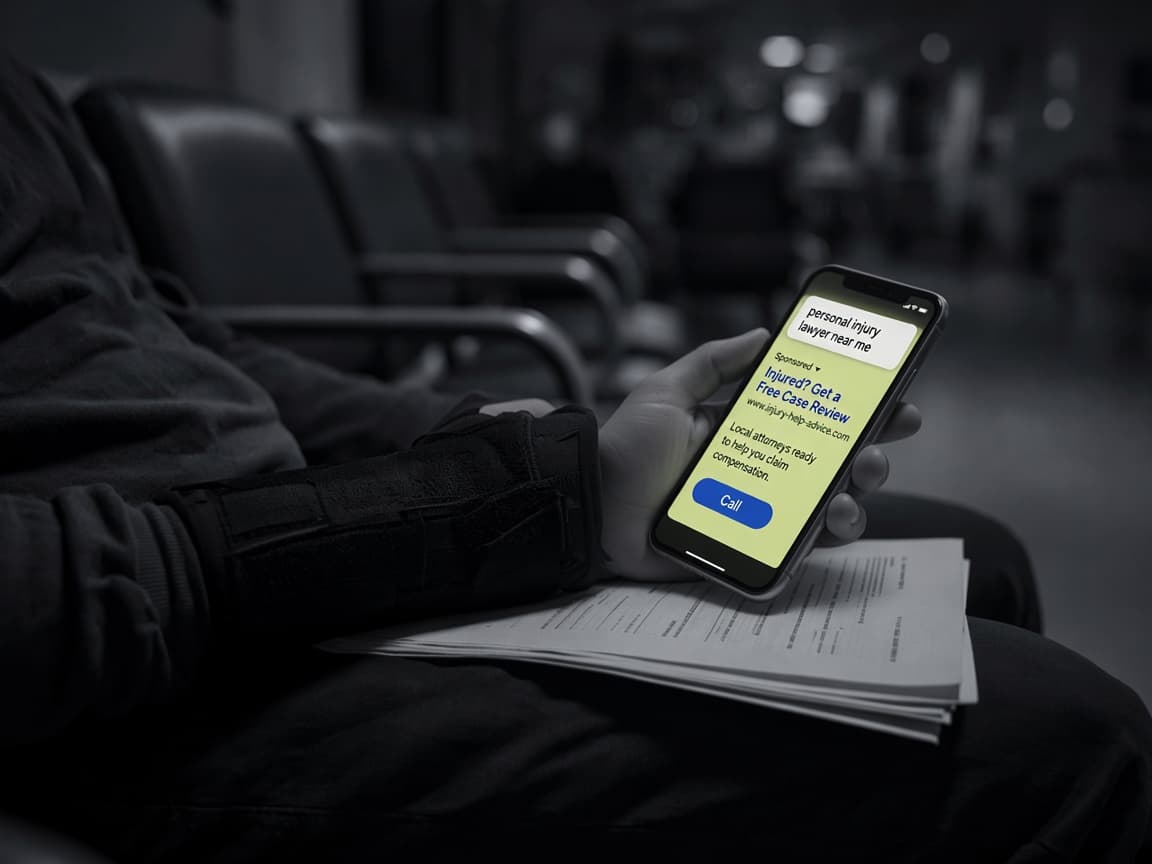
Many personal injury searches happen within days of an incident. The searcher may be dealing with medical appointments, an insurance adjuster, and a damaged vehicle at the same time. They are often on a phone, and often willing to call several firms in a row.
Not everyone searching injury terms needs a lawyer. Some want an accident report, some are researching what a claim is worth, some are law students or job seekers, and some were in an incident with no injury. A personal injury account that does not separate these groups pays for all of them.
Family members frequently search on behalf of an injured person. Messaging and intake should account for the caller not always being the claimant.
Reading search intent
The same practice area. Very different searches.
Every query is a decision: pursue it, give it its own message, watch it closely, or exclude it. These examples show how we think about personal injury searches. Real decisions depend on the firm’s accepted matters, markets, and search-term data.
| Search query | What it signals | Action |
|---|---|---|
| “car accident lawyer near me”Hiring intent with implicit location — a core target. | Hiring intent with implicit location — a core target. | Target |
| “18 wheeler accident attorney”High-intent, distinct matter type. Usually warrants its own ad group and messaging. | High-intent, distinct matter type. Usually warrants its own ad group and messaging. | Segment |
| “how much is my injury claim worth”Research intent. May convert with the right page, but should be measured separately. | Research intent. May convert with the right page, but should be measured separately. | Review |
| “personal injury lawyer salary”Career research. No client intent. | Career research. No client intent. | Exclude |
| “police accident report lookup”Records request. Rarely an inquiry the firm wants to pay for. | Records request. Rarely an inquiry the firm wants to pay for. | Exclude |
- Target
- — core hiring intent
- Segment
- — worth its own ad group and message
- Review
- — measure separately before scaling
- Exclude
- — add as a negative keyword
Campaign strategy
How we approach personal injury campaigns
Structure by matter type, not just by keyword
Car, truck, motorcycle, pedestrian, and premises cases often differ in case value, competition, and acceptance criteria. Separate campaigns make it possible to fund the matters a firm actually prioritizes rather than letting the cheapest clicks absorb the budget.
Geography is a strategic decision
Expanding a radius can lower costs per click while attracting incidents the firm cannot take. Location targeting should reflect where the firm accepts cases and where intake can realistically serve clients.
Calls deserve first-class measurement
Injury prospects often call rather than fill out forms. Call conversion settings, minimum call durations, and call tracking should be configured so a two-second hang-up is not counted the same as a ten-minute intake conversation.
Local Services Ads are a separate channel
Google Local Services Ads have their own eligibility and screening process. They can coexist with search campaigns, but they should be evaluated and reported separately so budget decisions stay clear.
Qualification & conversion
A lead is only useful if it fits the firm.
Common qualification signals
Starting points only — the firm defines what a qualified inquiry means for its practice.
- Accident type matches accepted case types
- Incident location within the firm's jurisdiction
- Injury and medical treatment involved
- Within an appropriate timeframe for the matter
- Not currently represented
Conversion path essentials
What the landing page and contact path need to do once the click is paid for.
- Dedicated pages per accident type that repeat the language of the search
- Click-to-call placed above the fold on mobile, with hours that reflect real intake availability
- Short forms that ask only what intake needs to respond — no confidential case details
- Clear explanation of how consultations work and what happens after the inquiry
Advertising rules
Attorney advertising rules vary by state, including rules on testimonials, past results, and terms like “specialist.” Ad copy and landing pages should be reviewed against the rules that apply to the firm.
Your next client may already be searching
Get More FromEvery LegalSearch.
If your law firm is investing in Google Ads — or preparing to launch — a focused, measurable PPC strategy can help you understand where the opportunities are and how to pursue them.
PPC strategy request
~2 minutes